
Understanding VSWR and Return Loss — The Mathematics of Power Reflection in RF Systems
VSWR & Return Loss — From First Principles to Practical RF Design
Theory that actually helps you build better antennas, tune matches, and protect your PAs — with equations, tables, and field-tested rules.
What you’ll get: intuition for standing waves, clean conversions among VSWR, Return Loss and \(|\Gamma|\), power reflection math, bandwidth/Q links, Smith Chart mini-guide, and matching recipes you can apply immediately.
Reflection Coefficient \( \Gamma \):
where everything starts
At a discontinuity (load \(Z_L\) on a line with \(Z_0\)), part of the wave reflects. The complex voltage reflection coefficient is
\[
\Gamma \;=\; \frac{V_{\mathrm{ref}}}{V_{\mathrm{inc}}}
\;=\; \frac{Z_L – Z_0}{Z_L + Z_0}
\;=\; |\Gamma|\,e^{j\angle\Gamma},\qquad 0\le|\Gamma|\le1.
\]
Magnitude \(|\Gamma|\) controls how strong the reflection is; phase \(\angle\Gamma\) controls where the standing-wave peaks/minima occur along the line. Purely resistive loads give \(\angle\Gamma\in\{0,\pi\}\); reactive loads rotate \(\Gamma\) around the Smith Chart.
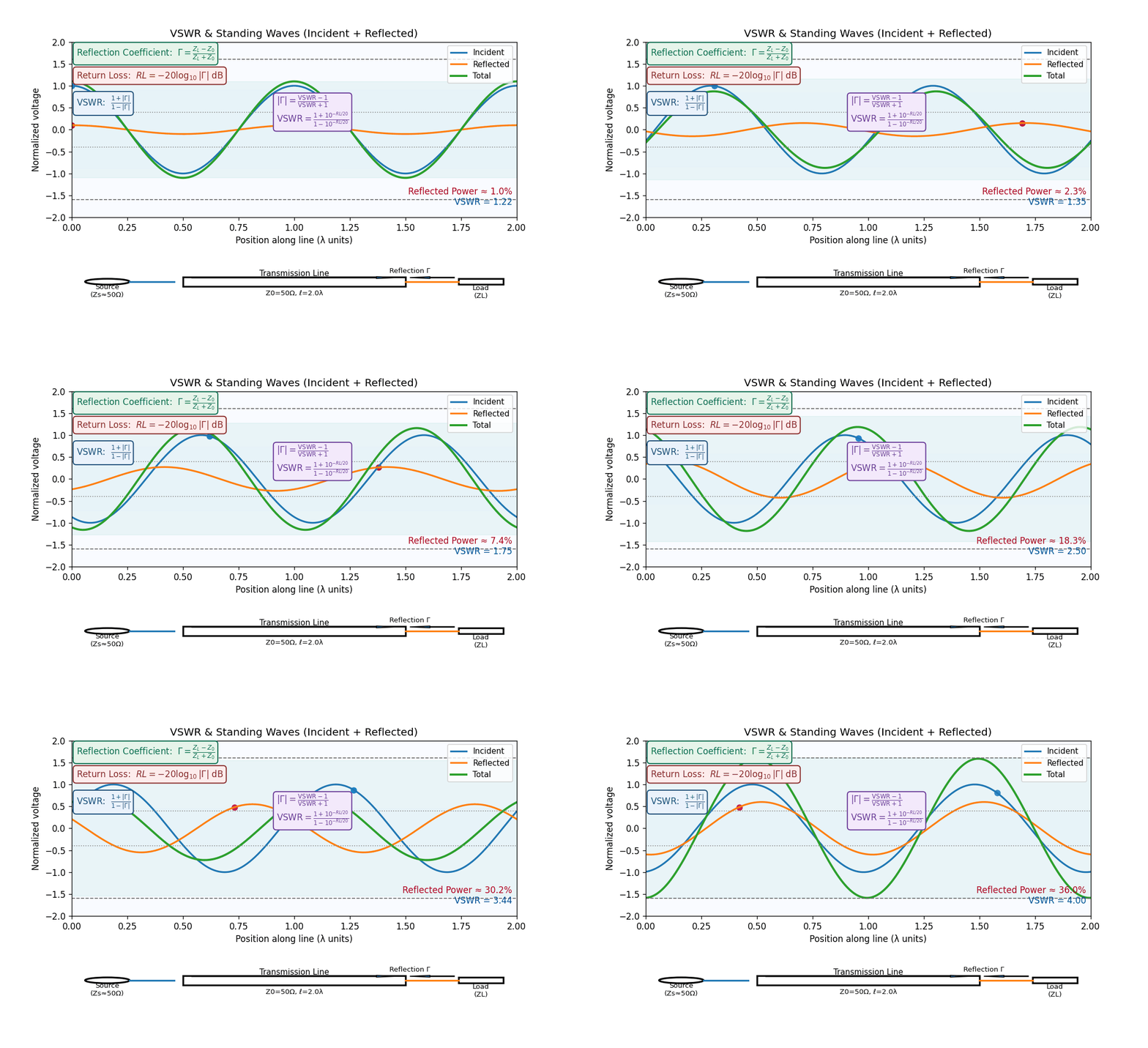
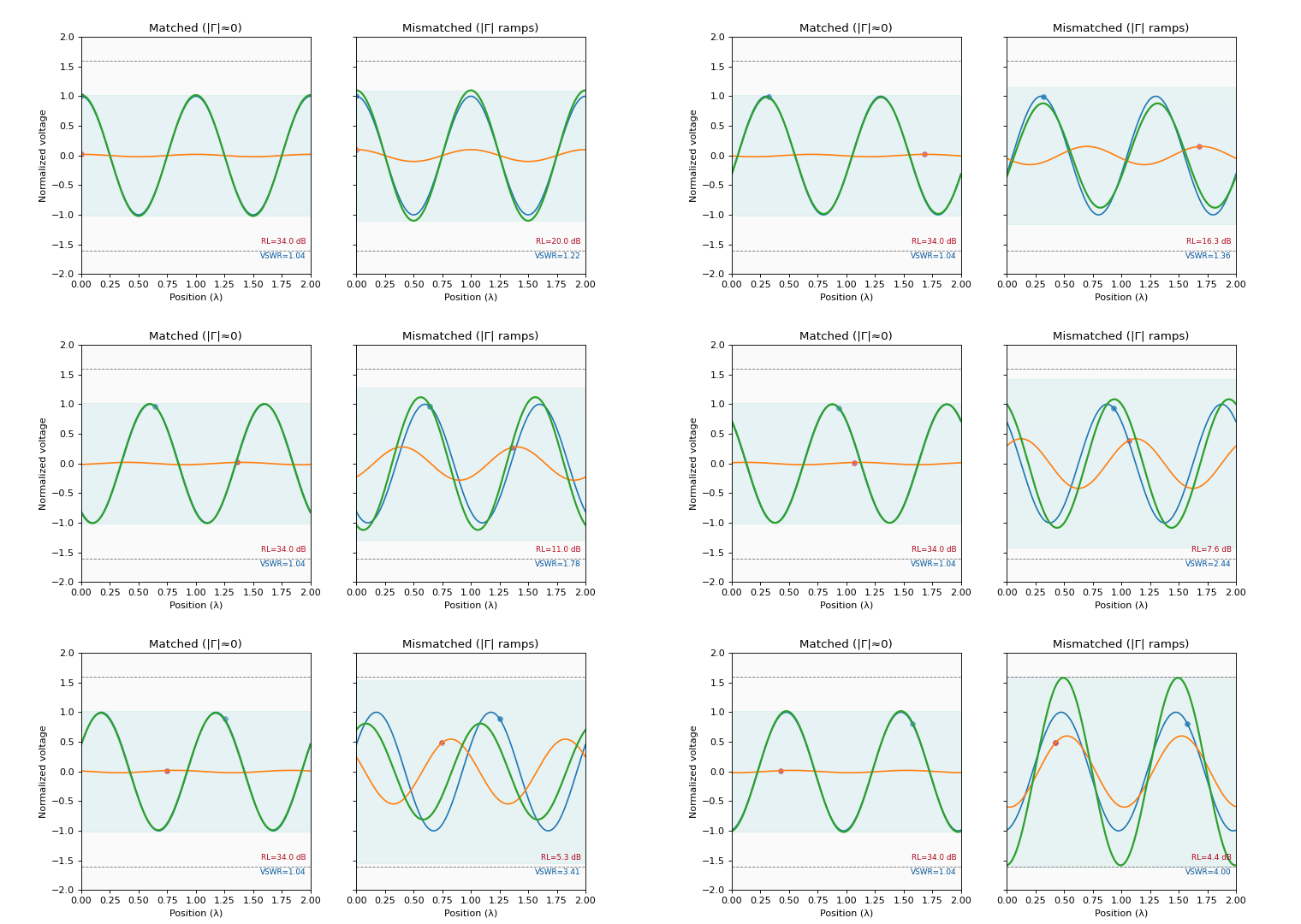
Standing waves & the definition of VSWR
The line voltage is the superposition of forward and reflected waves
\[
V(x)=V_0^+\big(e^{-j\beta x} + \Gamma e^{+j\beta x}\big),\qquad
\beta=\frac{2\pi}{\lambda}.
\]
This produces a stationary envelope with maxima/minima
\[
V_{\max}=V_0^+(1+|\Gamma|),\qquad V_{\min}=V_0^+(1-|\Gamma|).
\]
\[
\mathrm{VSWR}=\frac{V_{\max}}{V_{\min}}=\frac{1+|\Gamma|}{1-|\Gamma|}.
\]
Table 1 — Quick conversions & intuition
VSWR | \(|\Gamma|\) | Return Loss (dB) | Reflected Power | Match Quality |
|---|---|---|---|---|
1.0 | 0.000 | ∞ | 0% | Perfect |
1.2 | 0.091 | 20.8 dB | 0.83% | Excellent |
1.5 | 0.200 | 14.0 dB | 4% | Good |
2.0 | 0.333 | 9.54 dB | 11.1% | Acceptable |
3.0 | 0.500 | 6.02 dB | 25% | Poor |
Return Loss (RL) and S-parameters
Return Loss expresses reflections in dB and is directly what most VNAs display for \(S_{11}\).
\[
\mathrm{RL(dB)}=-20\log_{10}|\Gamma|,\qquad
|S_{11}| = |\Gamma|,\qquad \mathrm{RL} = -20\log_{10}|S_{11}|.
\]
Because decibels are logarithmic, small improvements in \(|\Gamma|\) can yield big RL gains (e.g., \(|\Gamma|:0.2\to0.1\) improves RL from 14 dB to 20 dB).
Power reflection, delivered power & mismatch loss
\[
\frac{P_{\mathrm{ref}}}{P_{\mathrm{fwd}}}=|\Gamma|^2,\qquad
P_{\mathrm{load}}=P_{\mathrm{fwd}}\,(1-|\Gamma|^2).
\]
\[
\mathrm{Mismatch\ Loss\ (dB)}=-10\log_{10}(1-|\Gamma|^2).
\]
Table 2 — Mismatch-loss quick reference
\(|\Gamma|\) | RL (dB) | VSWR | Delivered Power | Mismatch Loss (dB) |
|---|---|---|---|---|
0.10 | 20.0 | 1.22 | 99% | 0.04 |
0.20 | 14.0 | 1.50 | 96% | 0.18 |
0.33 | 9.54 | 2.00 | 89% | 0.51 |
0.50 | 6.02 | 3.00 | 75% | 1.25 |
Worked example (2.4 GHz antenna)
Let \(Z_0=50\,\Omega\) and measured \(Z_L=60+j10\,\Omega\).
\[
\Gamma=\frac{Z_L-Z_0}{Z_L+Z_0}=\frac{10+j10}{110+j10}\quad\Rightarrow\quad |\Gamma|\approx0.128.
\]
\[
\mathrm{VSWR}=\frac{1+0.128}{1-0.128}\approx1.29,\qquad
\mathrm{RL}=-20\log_{10}(0.128)\approx17.9\ \mathrm{dB}.
\]
Only \(|\Gamma|^2\approx1.6\%\) of the power reflects — a very good match.
Bandwidth, Q, and matching reality
Good match at a single frequency is easy; maintaining it across bandwidth needs low Q or broadband matching.
\[
Q \;\approx\; \frac{f_0}{\mathrm{BW}_{\mathrm{3\,dB}}}
\qquad\text{(narrower BW = higher Q)}.
\]
Reactive tuning elements (L/C) create frequency-dependent match. A great S11 dip at \(f_0\) often widens to poor VSWR at band edges. Always check \(S_{11}(f)\) and, for antennas, efficiency/gain as well.
Smith Chart mini-guide (30 seconds)
Normalize load: \(z_L = Z_L/Z_0\), plot it on the chart.
Constant-\(|\Gamma|\) circles = constant VSWR rings.
Moving along a lossless line rotates the point around the chart by \(2\beta l\).
Goal: move \(z_L\) to the chart center (match) using series/shunt L/C, line stubs, or transformers.
Matching recipes you’ll actually use
A) Conjugate match (lumped L/C)
If source is \(Z_S=R_S+jX_S\) and load is \(Z_L=R_L+jX_L\), a conjugate match makes the load as seen by the source equal to \(R_S-jX_S\). Net reactance cancels, maximizing power transfer. You can implement with L-, \(\pi\)-, or T-networks (series + shunt elements).
B) Quarter-wave transformer
For purely resistive \(R_S\) and \(R_L\) at design frequency \(f_0\), a \(\lambda/4\) section of line with impedance \(Z_t\) gives a perfect match:
\[
Z_t \;=\; \sqrt{R_S R_L},\qquad \ell=\frac{\lambda}{4}.
\]
Off \(f_0\), the match degrades — this is narrowband but elegant.
C) Single-stub shunt matching
Transform \(Z_L\) to a point with admittance \(Y=G+jB\) where \(G=1/Z_0\); then place a shunt susceptance \(B_s=-B\) using an open/short-circuited stub of appropriate length.
D) Practical sequence (cheat-sheet)
Measure \(S_{11}(f)\) at the intended reference plane.
If reactive: cancel \(X_L\) first (series/shunt L/C).
Bring resistance toward \(Z_0\) with L/\(\pi\)/T network or QWT.
Iterate and verify over bandwidth; watch efficiency for antennas and stability for PAs.
Measurement & de-embedding gotchas
Calibrate properly (OSL or TRL) at the DUT plane; adapters after cal will skew \(S_{11}\).
Cable flex changes phase → apparent \(S_{11}\) ripple; use stable fixturing.
PA protection: know max allowable VSWR at rated power; many PAs derate or fold back above 2:1–3:1.
Table 3 — Typical targets by application
| Application | VSWR | Return Loss | Notes |
|---|---|---|---|
| Lab calibration standards | ≤ 1.10 | ≥ 26 dB | Verification of system error |
| PA input/output matching | ≤ 1.50 | ≥ 14 dB | Stability & efficiency |
| Consumer Wi-Fi antennas | ≤ 2.00 | ≥ 9.5 dB | Cost-effective build |
| Satcom terminals | ≤ 1.20 | ≥ 20 dB | Tight link budgets |