
How Does an Antenna Radiate? A Maxwell-Based Story
Modern wireless communication rests on a simple-looking object — a piece of metal that launches energy into space. The concept of antenna radiation did not appear overnight. It is the result of more than a century of theoretical and experimental work linking electricity, magnetism and waves.
In 1864, James Clerk Maxwell unified electric and magnetic phenomena into a single set of equations and predicted the existence of electromagnetic waves. At that time, this was pure theory. In the late 1880s, Heinrich Hertz built spark-gap oscillators with wire loops and small gaps, creating the first intentional radiators and receivers. His experiments demonstrated reflection, refraction and polarization of radio waves — and confirmed that Maxwell’s predictions were physically real.
Soon after, Guglielmo Marconi recognized the practical potential of these waves for communication. His tall vertical wires with ground systems — early monopole antennas — enabled long-distance wireless telegraphy. Over the following decades, engineers developed Yagi–Uda arrays, parabolic reflectors, horns, log-periodic antennas and printed patches. Despite their geometric variety, all are governed by the same principle: a time-varying current on a finite conductor produces fields that cannot remain confined, and Maxwell’s equations demand that part of this energy propagates away as a wave.
1. The Physics Foundation: Alternating Currents and Electromagnetic Fields
Consider an RF source driving a conductor at angular frequency \( \omega = 2\pi f \). The terminal current can be written in phasor form as
The associated current density \( \mathbf{J} \) and charge density \( \rho \) satisfy the continuity equation
This equation guarantees that if current varies with time, charges must accumulate and deplete on the conductor surface. These time-varying charges give rise to an electric field \( \mathbf{E} \), while the current flow itself generates a magnetic field \( \mathbf{H} \) around the conductor (Ampère’s law).
In a well-designed transmission line, the geometry constrains these fields into a guided mode. For a coaxial cable supporting TEM mode:
- the electric field is predominantly radial between inner and outer conductor,
- the magnetic field circles the inner conductor,
- the power flows along the axis, described by the Poynting vector \( \mathbf{S} = \mathbf{E} \times \mathbf{H} \).
As long as the line is uniform and terminated in its characteristic impedance, no significant radiation occurs. Fields remain “trapped” between the conductors, and power simply flows from source to load. The situation changes drastically at any discontinuity where this confinement breaks down — and that is where antennas live.
2. Why Radiation is Inevitable: The Role of Maxwell’s Equations
Maxwell’s curl equations in phasor form explain why time-varying fields naturally tend to propagate away from their sources:
\( \nabla \times \mathbf{H} = \mathbf{J} + j\omega \varepsilon \mathbf{E} \quad \) (Ampère–Maxwell law)
The first equation tells us that a changing magnetic field induces an electric field. The second shows that a combination of conduction current density \( \mathbf{J} \) and displacement current density \( j\omega\varepsilon \mathbf{E} \) induces a magnetic field. Together, they imply that once time-varying fields exist, they tend to sustain one another and can detach from the conductors to form traveling waves.
In a homogeneous, source-free region (\( \mathbf{J} = 0 \)), we can express the fields purely in terms of themselves. Eliminating \( \mathbf{H} \) from the curl equations yields the vector wave equation:
and similarly for \( \mathbf{H} \), where
is the wave number in the medium. Any time-varying current on a finite conductor creates fields that cannot be confined to the immediate vicinity of the metal; in the surrounding space, these fields must satisfy the above wave equations. In simple words, once we have time-varying currents and no perfect enclosure, some energy must leave as a wave.
3. The Radiation Point: Field Detachment at a Geometric Discontinuity
Inside a uniform transmission line, the conductor surfaces provide boundary conditions that support a specific guided mode. On an ideal conductor, the tangential electric field must vanish:
and the tangential component of the magnetic field is related to the surface current density \( \mathbf{J}_s \) via
At the open end of a dipole or the edge of a microstrip patch, the conductor stops abruptly. The guided mode, which relied on specific geometry, can no longer exist in its previous form. The surface current must go to zero at the open end, causing charge accumulation. This results in strong fringing fields that spread into the surrounding space instead of remaining confined between conductors.
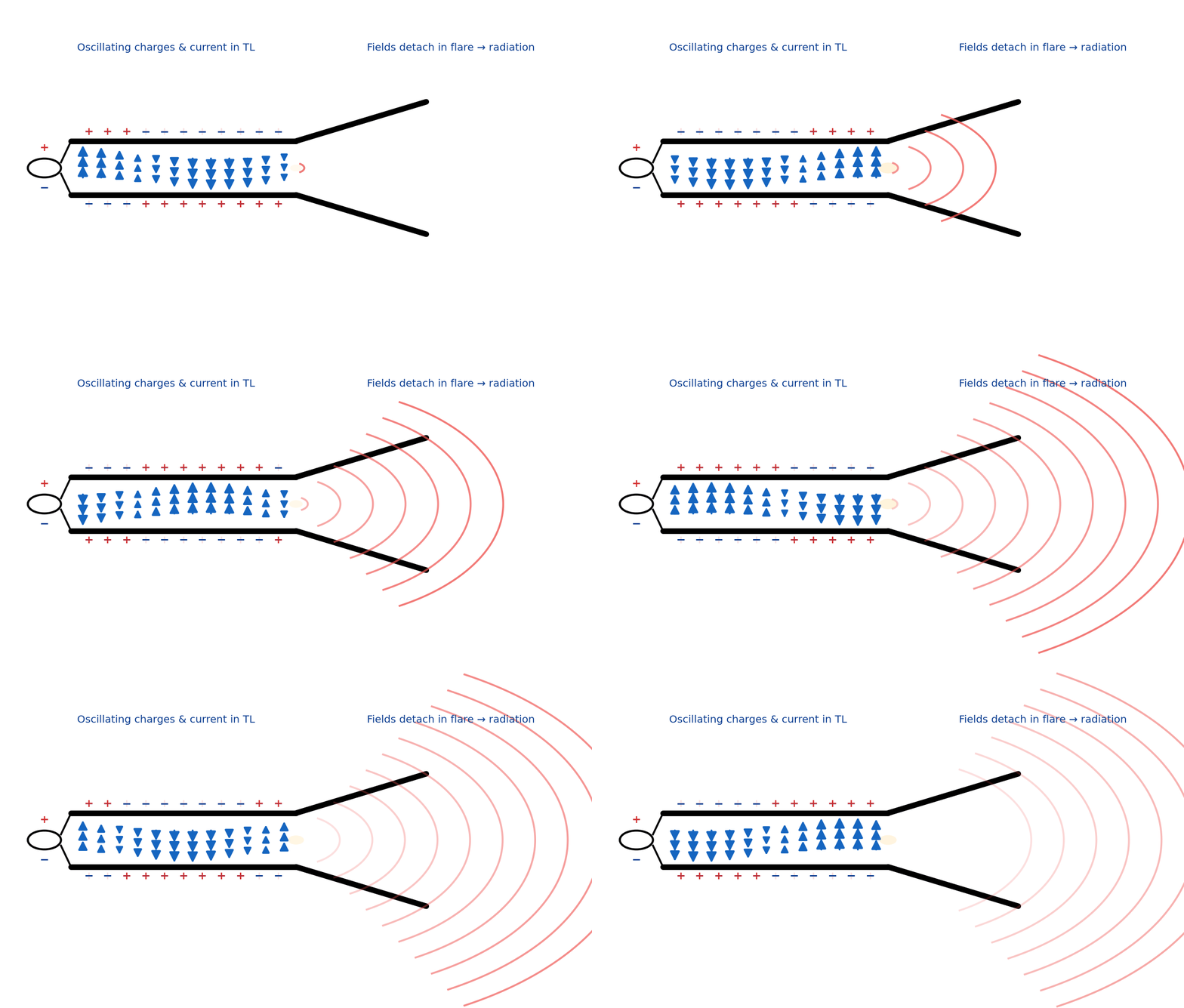
These fringing fields are no longer well described as a transmission-line mode. In the region outside the conductors, they must satisfy the homogeneous wave equation \( \nabla^2 \mathbf{E} + k^2\mathbf{E} = 0 \). The solution to this equation in spherical coordinates for localized sources is a radiating spherical wave. This is how the antenna acts as a transition device: it converts the guided wave on a line into a free-space wave.
4. Classic Example: Fields of the Hertzian Dipole
To see the structure of radiated fields analytically, we start with the simplest radiator: a short (Hertzian) dipole of length \( \ell \ll \lambda \), located at the origin, oriented along the \( z \)-axis, carrying current \( I_0 e^{j\omega t} \). The current density is often modeled as
where \( u(\cdot) \) is a unit window function along the wire. The magnetic vector potential \( \mathbf{A} \) in free space is
For a very short dipole, the distance variation within the source region can be neglected, yielding approximately
From \( \mathbf{A} \), we can obtain the fields using
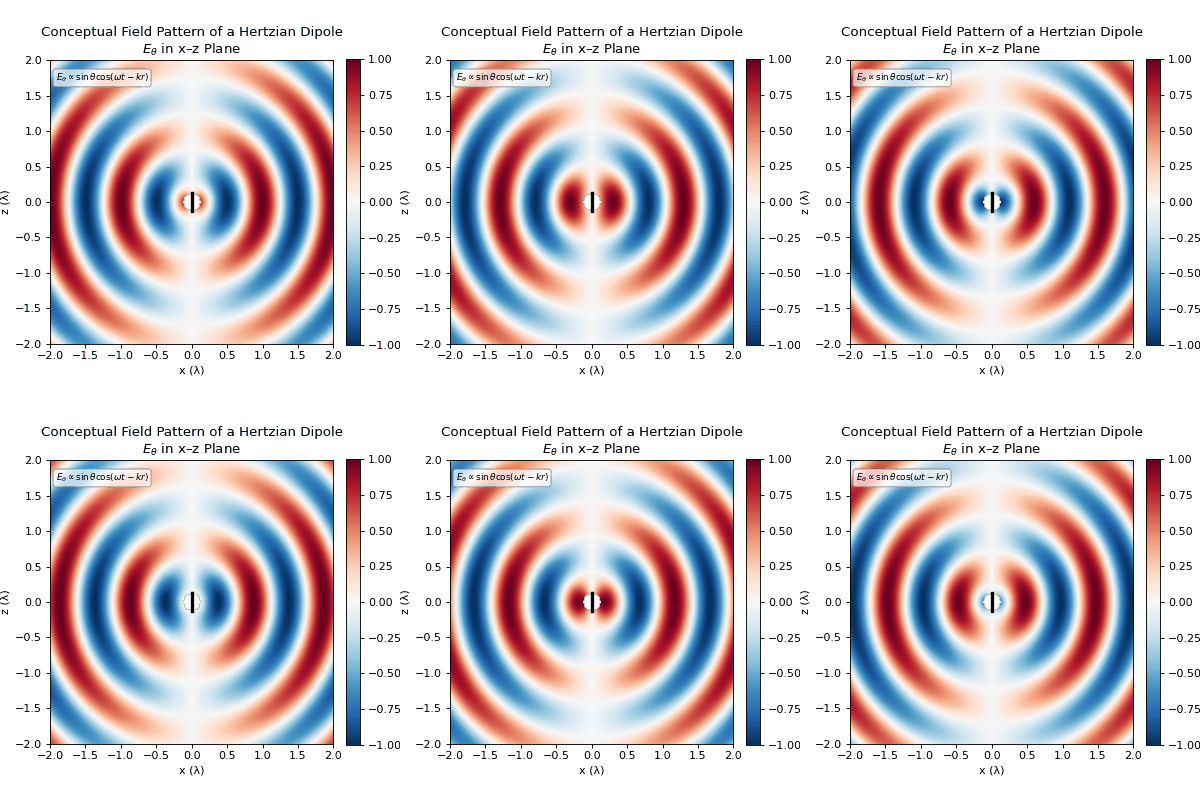
After standard manipulations and retaining only the dominant far-field terms, the radiated fields in spherical coordinates are
These expressions show that the fields fall as \(1/r\), exhibit a \(\sin\theta\) pattern (maximum at broadside, zero along the axis), and have a phase factor \(e^{-jkr}\) describing an outward-traveling spherical wave. This mathematical form is the prototype of radiation.
5. Stored Energy vs Radiated Energy: Near Field and Far Field
If we do not throw away the higher-order terms in the derivation, the total field of the small dipole in the \(\theta\)-direction can be written qualitatively as
Each of these terms has a different physical meaning:
- The \(1/r^3\) term dominates very close to the antenna. This region is called the reactive near field, where energy oscillates between electric and magnetic forms but does not contribute to net radiation.
- The \(1/r^2\) term corresponds to the induction field, still closely tied to the source and not yet a fully developed radiating wave.
- The \(1/r\) term dominates at sufficiently large distances, where the wavefronts become approximately spherical, and power flow is essentially one-way outward. This is the radiation field.
In antenna engineering, we define a boundary between near field and far field so that radiation characteristics (pattern, gain, polarization) can be measured and used meaningfully. A commonly used criterion for the beginning of the far field is
where \( D \) is the largest dimension of the antenna. Closer than this distance, the angular distribution of fields can be distorted by reactive and induction terms. Beyond it, the \(1/r\) term dominates, and the field pattern becomes essentially independent of distance.
The time-average power density at a point in space is given by the real part of the Poynting vector:
For the small dipole, substituting the far-field expressions for \( \mathbf{E} \) and \( \mathbf{H} \) into \( \mathbf{S} \) and integrating over a sphere of radius \( r \) yields the total radiated power:
where \( R_r \) is defined as the radiation resistance. For the Hertzian dipole,
This concept is very powerful: it allows us to treat radiation as if it were an equivalent resistor in series with the antenna, converting RF current into radiated power rather than heat. It is the bridge between field-based calculations and circuit-based intuition.
6. Connecting Fields to Circuits: Antenna Input Impedance
From the terminal perspective, an antenna behaves like an impedance
Here \( R_r \) is the radiation resistance we just defined, \( R_l \) is the loss resistance representing conductor and dielectric losses, and \( X_a \) is the reactance associated with stored near-field energy. At the antenna feed, if the phasor current is \( I \), then the time-average radiated, lost and reactive powers can be written as
and near-field reactive energy is linked to \( X_a \). We define radiation efficiency as
For a center-fed half-wave dipole in free space, field analysis gives
In practice, we seldom operate at exactly one frequency. The antenna reactance varies with frequency, and the input impedance can be expressed as
where both \( R_a(f) \) and \( X_a(f) \) depend on geometry and environment. The reflection coefficient seen by a source with line impedance \( Z_0 \) is
and the fraction of power delivered to the antenna is
Field-based calculations determine \( R_r \) and the radiation pattern; circuit-based matching networks ensure that the source sees an impedance close to \( Z_0 \), minimizing reflections and maximizing power transfer. In essence, the input impedance is the circuit-level signature of the field behavior around the antenna.
7. Reception as the Reverse Process: Effective Length and Effective Area
The same physics that explains transmission also governs reception. When a plane wave with electric field \( \mathbf{E}_{\mathrm{inc}} \) impinges on an antenna, it induces currents along the structure. These currents, integrated along the conductor, produce a terminal voltage. A useful quantity is the effective length \( \boldsymbol{\ell}_{\mathrm{eff}} \) of the antenna, defined such that the open-circuit voltage at the terminals is
For a simple half-wave dipole aligned with the incident electric field, the magnitude of \( \ell_{\mathrm{eff}} \) is on the order of \( \lambda/2 \) times an efficiency factor depending on the current distribution. This effective length emerges from the same current patterns that produced radiation during transmission; reciprocity guarantees the symmetry.
Another powerful receive parameter is the effective area \( A_e \). For an antenna with power gain \( G(\theta,\phi) \), the effective area in the direction of maximum gain is related to gain by
If the incident plane wave has power flux density \( S_{\mathrm{inc}} \) (W/m²), then the power available at the antenna terminals (under conjugate match) is
This ties together three views:
- field view: \( \mathbf{E}_{\mathrm{inc}}, \mathbf{H}_{\mathrm{inc}} \),
- aperture view: effective area \( A_e \),
- circuit view: terminal voltage \( V_{\mathrm{oc}} \) and available power.
Because the same current distribution determines \( G(\theta,\phi) \), \( A_e \) and \( \ell_{\mathrm{eff}} \), an antenna that is a good radiator in a certain direction is also a good receiver from that direction. This is the practical statement of the reciprocity theorem for antennas.
8. A Unified Picture of Antenna Radiation
We can now summarize the radiation process in a single, coherent narrative:
- An RF source drives an alternating current on a conductor. The time-varying current and charge system creates time-varying electric and magnetic fields.
- Inside a transmission line, the conductor geometry enforces boundary conditions that confine these fields in a guided mode with negligible radiation.
- At an antenna structure (open end, flare, patch edge), the geometry changes. The guided mode can no longer be sustained; surface currents must terminate, and charges accumulate, producing strong fringing fields.
- These fringing fields extend into the surrounding space and, away from conductors, satisfy the source-free wave equation \( \nabla^2\mathbf{E} + k^2\mathbf{E} = 0 \), resulting in outward-traveling spherical (or quasi-spherical) waves.
- Close to the antenna, fields include \(1/r^3\) and \(1/r^2\) terms and represent stored reactive energy. Farther away, the \(1/r\) term dominates and carries real power away from the antenna, quantified via the Poynting vector.
- Integrating this power over a closed surface gives the radiated power and defines the radiation resistance \( R_r \). Adding conductor losses yields the input impedance \( Z_a = R_r + R_l + jX_a \), which connects fields to circuit behavior.
- In reception, the same geometry that produced a given radiation pattern now collects energy from an incident wave. The effective length and effective area describe how much voltage and power appear at the terminals, linked directly to the gain pattern via \( A_e = \lambda^2 G / (4\pi) \).